

The Pied Piper (1942)
God Save The Kids

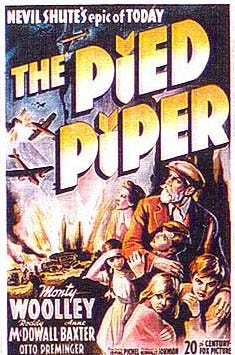
Welcome to June and welcome to ILTBTA’s Cinematic Lampoon: European Vacation! Our first stop is World War II-era France to see if a curmudgeonly old British dude can shepherd a motley crew of children across the country to safety across The Channel. Watch out for Nazis and read on! (Oh and don’t forget your passport!)

Previews
What, if anything, did we know about this coming attraction before we watched it?
Ellen: Piper? I hardly know her!
Tyler: When I started my first job out of college, the other newbies and I would follow our team lead to meetings with the bigwigs and someone once called him “The Pied Piper.” Here endeth my knowledge of this movie.
Plots & Feelings
This one’s pretty self-explanatory.
Short Version (courtesy of IMDb): While traveling in France during the Nazi invasion of 1940, an Englishman is entrusted with the care of a group of refugee children.
Long Version (modified from Wikipedia and formatted to fit your screen):
It’s 1940, and John Sidney Howard is old, British, and absolutely chilling in an inn in France near the border of Switzerland. He’s been dividing his time between fly fishing and attempting to avoid the Cavanaugh children, Sheila and Ronnie, who are staying at the inn with their parents. Howard already got into one debate with Ronnie about whether or not Rochester is an American state (and it most certainly is, per Howard), and he’s keen to avoid more interactions. While the guests are listening to the radio one evening, they learn that France and Belgium are now under German occupation.
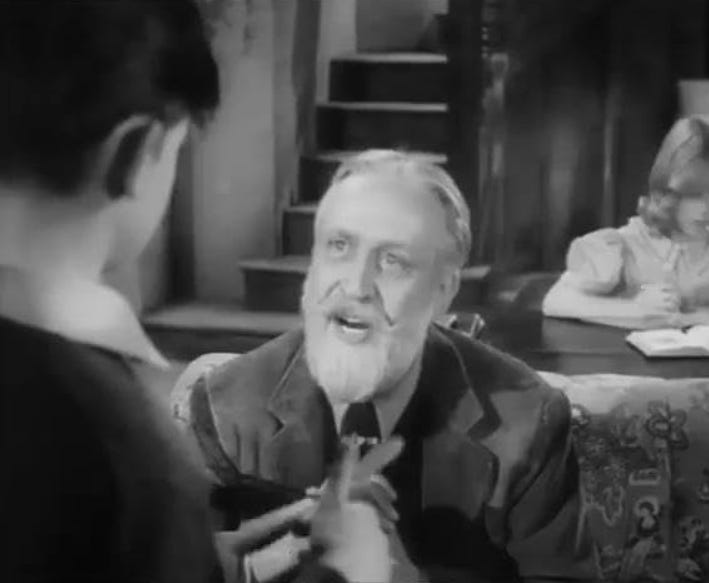
And we have our inciting incident, folks! We learn (via him chewing out a man who says they should have made terms with Hitler when they had the chance1) that Howard offered his services to every government department in London but was turned down for being too old. He’d gone to France to sulk2, but the invasion spurs him to go home and do his part, even if all he can do is knit. Hearing that he’s returning to London, Mrs. Cavanaugh approaches him with a request. Mr. Cavanaugh is in the League of Nations, and they have to return to his post in Geneva. It’s a terrible imposition, but will Howard accompany the kids back to England? After some very fair inquiries about the degree to which these youths can care for themselves, Howard reluctantly agrees to the 18 hour train ride.
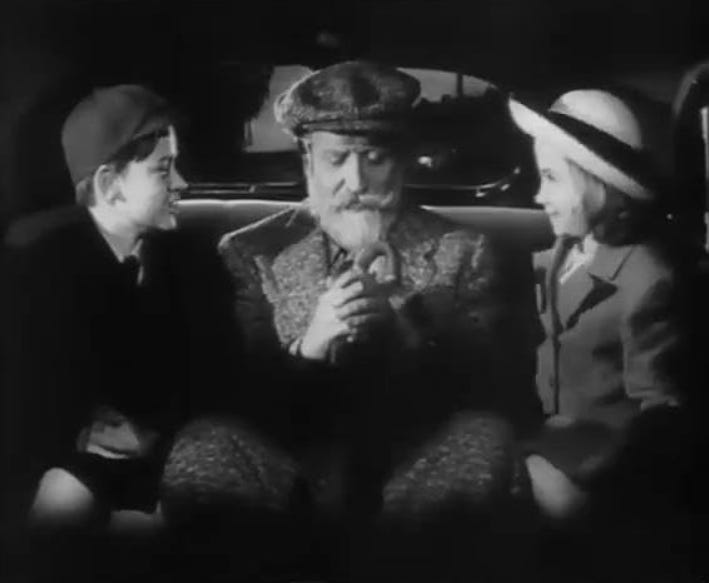
The unlikely trio is stopped short on their journey when their train stops at Joigny. Germans have broken through Allied lines, nothing else is running north, and what’s worse: no porters at the station!! Sheila has been trainsick, but some nice French ladies and their kids help look after her in the station. Eventually they find a bus headed for Chartres, and Howard gives the kids chocolate bars for good behavior, all three of them. Wait a minute?! A French girl named Rose was sent with them by her aunt in hopes that Howard would drop her off in London at the hotel where her father works. Howard rips up the address he’s handed … but almost immediately relents.
Ellen: Howard talks a big game, “blah blah I despise children, I’m going to rip up this address, wahh wahh.” But you never really think he’s not going to help them.
Tyler: I suppose the children didn’t know that for sure, but you’re right: there’s never one moment where you think the actual protagonist of the movie is ever going to straight-up abandon a child. The rest of the movie is just the arc of him realizing that for himself.
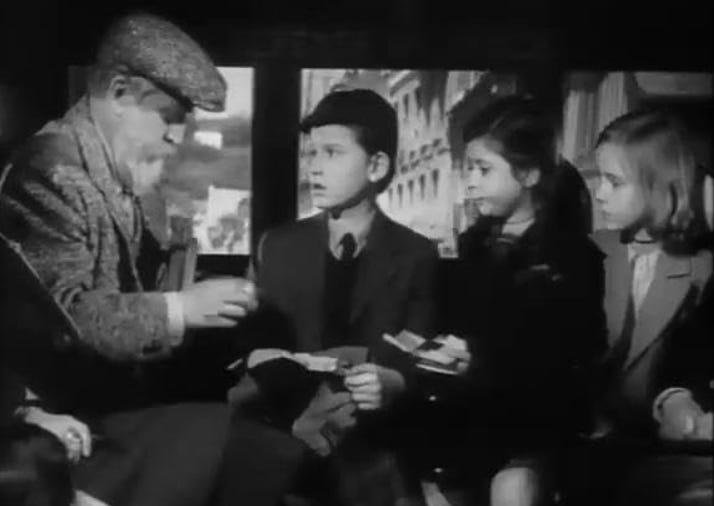
Bang! A tire on their bus blows out, so the group takes their packed lunch by a nearby stream. It’s borderline pleasant until (even more concerning) BANG!! German planes attack the refugees on the road. Howard is the first to peek over the ridge and see the destruction and bodies. There’s nothing for it, so they get their bags from the bus and start walking. When they come to rest at a barn for the evening, Howard discovers they have acquired a new child! He is assured by Sheila that this is a young boy named Pierre, but seeing as he neither speaks nor seems to hear, Howard is unclear on how she knows that. His parents were killed in the bus bombing, and he beds down in the hay with the rest.
Tyler: I thought the strafing scene looked pretty realistic! I’m guessing that’s how the cinematographer earned his Oscar nomination.
We cut to the group roaming the streets of Chartres with a baby carriage?! No, they have not gained an infant: it’s just for their bags. While they’re walking, German soldiers roll into town, and Pierre freaks out and starts hitting them with a stick. Thankfully, even these guys aren’t going to hurt a kid, and Ronnie and Howard haul Pierre into a bakery before they can change their minds. The group agrees to speak no more English, and since Howard is the only one who doesn’t speak French, this is fine: he just pretends to be deaf and a little crazy.
Ellen: We won’t give these soldiers too much credit though: they pantomime shooting Pierre and seem to think it’s hilarious.
They obtain directions to the home of Howard’s vacation friends from last year, Nicole Rougeron and her mother. Once at the house, a fifth child appears! This is Willem, he’s Dutch, he’s been with us on and off for the day, and he speaks neither French nor English. Howard eventually gives up trying to understand how Sheila has this information and is just like “sure, okay, stay quiet.” Howard and Nicole catch up, and Howard reveals that his son John, an RAF pilot, was shot down two months ago. Nicole gets a faraway look that Howard misses, but I’m sure we’ll hear about later…
Just as everyone has dozed off, German soldiers are at the door! Nicole manages to spirit everybody away to a train while her mother indignantly submits to a search of the home. While on the train to the Brittany coast and discussing how much can change in a year, Nicole reveals that she and John had been writing to each other since they met. They spent three beautiful days in Paris, and they’d planned to tell their families after the war.
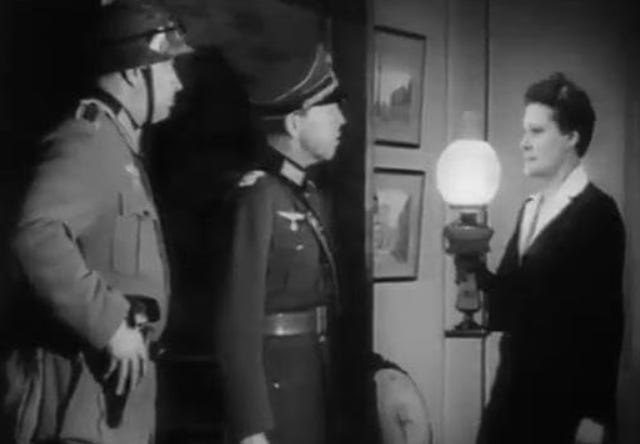
In Landerneau, Nicole appeals to her uncle Aristide, who owns fishing boats. He’s initially suspicious and honestly angry that they’d put him in this position, but he eventually finds a man, Focquet, willing to take them to England. Howard repeatedly entreats Nicole to come with them to England, but she insists it’s her duty to help France. Unfortunately, on their way through the German-occupied town, Sheila gets into a fight with Rose and speaks English within earshot of a German soldier. They are all captured at the dock and taken to Major Diessen.
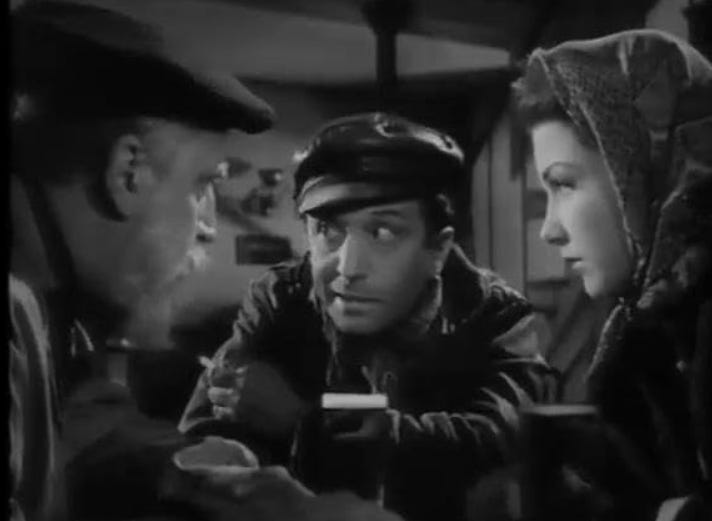
The group is taken to a room full of swastikas and bad vibes. Diessen is certain Howard is working for British Army intelligence, using the children as a cover. After initial questioning, they’re all placed in a room together, where Howard writes a new will, leaving everything to Nicole for the care of their little crew of randos. Diessen’s next attempt to squeeze information involves making Howard watch the execution of the spy, unless he gives up information. Howard doesn’t know, so he can’t comply, and they shoot the spy. Throughout, he shows a classic British “stiff upper lip” attitude, seeming to take it all in stride, but he’s terrified for the kids and Nicole. Focquet is also there.

The next ploy is … a lovely garden luncheon? The kids are thrilled to be outside, and even the adults manage to enjoy themselves until Howard is summoned for “the bill.” Diessen grills him about the plan for the children. Howard would like to get them all to America, where it’s safer. His daughter is married to a wealthy American. Diessen sneers at the idea that they’d take all these kids, even the Jewish one, and Howard defiantly replies that he knows of no restrictions, and they’d even take in a German! The Nazi is like “those were the magic words, thank you sir, please take my half-Jewish niece out of this hellscape, danke schön.” Howard agrees to take her to her other uncle in … I’m so sorry, did you say the city of Rochester?!
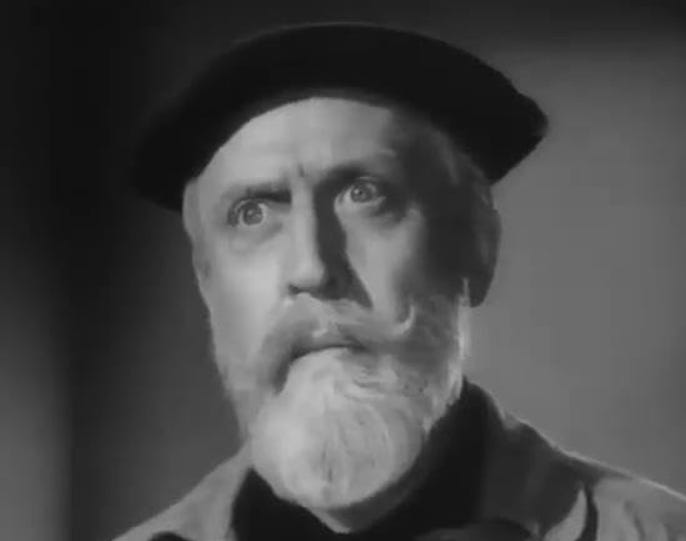
The gang is finally allowed to board Focquet’s boat, now with a cute little German girl. They’ll work on getting her to stop heiling Hitler on the way back … Howard and Nicole share a heartfelt goodbye, while Diessen reminds them that he’ll be watching her until he hears his niece is safe. As the voyage gets underway, Howard admits to Ronnie that he was wrong about Rochester.
Later, safely home, Howard is asked at his club if he “had much difficulty getting back?” He replies, “No ... not too much” as the walls shake from The Blitz.
Intermission
Even though ILTBTA is free, please indulge us further and enjoy this quick “advertisement.”
This installment of ILTBTA is brought to you by … Howard’s Knitting Services!
You there, soldier! You chilly in that foxhole? Care for a nice warm scarf in a tasteful and subdued Army green? Coming right up! How about you, my dear medic, surely a cable-knit throw blanket will be just the thing to help cheer your wounded charges? Free of charge, free of charge … Even you, Cooky, you can’t be grabbing that giant pot of chow with your bare hands! Please, avail yourself of my expertly crafted potholders, and no, they are not just scraps from failed projects when I was learning, how dare you!! Ahem, forgive me, there’s a good lad, take a handful.
Howard’s Knitting Services: The Purl of the British War Effort!
Wiki-Wiki-Whaaat?
Love a good Wikipedia rabbit hole in search of some fun facts? Us too.
The Pied Piper’s Wikipedia page has some interesting facts and anecdotes that we recommend you read through, but here are a few of our favorites:
Once again, The Pied Piper (movie) is based on the novel of the (nearly) same name, also released in 1942. The novel was written by renowned aeronautical engineer Nevil Shute Norway, who went by the pen name Nevil Shute to avoid potentially adverse publicity from his novels and fear that his employer or co-workers would find him to be “not a serious person.”
Ellen: Name so silly I told Tyler it was a typo.
Tyler: A stereotypical lack of creativity from an engineer. You could’ve picked literally any other name and you just go with your first and middle name?
In a much less common WWW bullet lead-in, the Pied Piper novel was based on the old German folk legend the “Pied Piper of Hamelin.” As the legend goes, a piper dressed in multicolored (or “pied”) clothing is hired by a town to lure rats away. After the burgermeister reneges on the promised payment, the piper uses his magical instrument to lure away the town’s children. The fate of the children varies based on the various versions of the legend.
Tyler: This kind of sounds like the plot of Weapons?
Ellen: It’s not not like Weapons.
Okay back to the movie we just watched. The Pied Piper was directed by acclaimed actor/director Irving Pichel3. Pichel worked as a character actor in films during the 1930s, including in a “low budget version” of Oliver Twist (not the version we just covered), future ILTBTA subject Cleopatra (not the Elizabeth Taylor one we covered a few years ago), and past ILTBTA subject Jezebel.
Throughout the 1940s, Pichel transitioned to directing and worked on several anti-Nazi/pro-British war films before the U.S. entered WWII. He then transitioned to film noir and science fiction, directing the early Technicolor film Destination Moon. This was the first major American sci-fi film to discuss the practical challenges of space travel and speculate what crewed lunar expeditions would look like.
The protagonist, Howard, was played by Monty Woolley (full name Edgar Montillion Wooley). He was affectionately known as “The Beard” and even had his beard (and hands) impressed in the pavement at the Chinese Theatre.
Howard’s French friend Nicole was played by Anne Baxter, best known for her later work in future ILTBTA subjects The Magnificent Ambersons, The Razor’s Edge, and All About Eve. Fun fact: Baxter is the granddaughter of famed architect Frank Lloyd Wright.
Baxter lost second billing, however, to child actor Roddy McDowall (Ronnie), who the prior year had earned acclaim for his work in How Green Was My Valley. McDowall enjoyed a long acting career, with highlights including Lassie Come Home, the aforementioned Elizabeth Taylor version of Cleopatra, and multiple Planet of the Apes movies.

Oscar NomNomNomz
Since we all know a movie is nothing without the food and drink it incorporates.
It’s now time to award the Oscar for Best Snacktor in a Supporting Role4. And the nomnomnominees are:
Two small fish from the river for supper
A celebratory bar of chocolate after successfully acquiring another child
A full meal in the garden from your Nazi captors
A glass of port at the club upon your arrival back in London
And the Oscar goes to … the celebratory bar of chocolate! Unfortunately, yet another child has entered the picture and taken the chocolate, so we will accept this award on its behalf.
Fill In The Blank
How did we really feel about The Academy nominating this?
Ellen: I’d like to allow The Academy to shelter in my house, but I will be kicking their butts out as soon as the Nazis show up. I enjoyed this more than I expected to! I thought that Howard was going to be more out-and-out curmudgeonly, whereas most of the time he was just kind of mildly irritated. He gave more guff to the adults along the way who impeded their journey than the kids themselves. He seemed more bemused than angry when it came to the kids, which is the right tone if we’re sticking with this guy. I’d also have been willing to forgive if it were more propaganda-y (see Tyler’s comments below) given when it came out. To Tyler’s other point, we knew they’d make it out, but there were sufficient twists, turns, and jokes to keep us entertained on the trek.
Tyler: I’d like to give The Academy some chocolate for making it onto the bus then slowly drift off to sleep. I found this to be an overall pretty well-made and well-acted story that just skirts the line before crossing into heavy-handed WWII propaganda. As I mentioned in P&F, we get to see Howard's arc from child-hating curmudgeon to protective grandfather figure while also getting some backstory and depth about why he is the way he is, which feels very real given the backdrop. The story wisely deploys the kids early on to suck you in and set up the stakes but then gradually tapers them off to focus on our titular character. And while the end is never really in doubt, it was always about the journey anyway.
For a movie that’s under 90 minutes (and was free to watch) it’s hard to ask for much more.
4/5 ⭐on Letterboxd
Let The Credits Roll
Thanks for reading! Some quick housekeeping as you exit the theatre:
If you have plots and feelings of your own (on the movie or ILTBTA in general), feel free to comment on the post or simply reply to the email. If you liked reading this: tell your friends! If you hated reading this: tell your friends how much you hated it by forwarding it to them!
Since Twitter is a hellscape of hatred and Russian bots, we’ve taken our talents to Bluesky! Follow us there for alternate subtitles and even more jokes and gifs.
ILTBTA is also on Letterboxd, the social networking/movie review site for movie fans. Follow us there to read our Spreadsheet comments of our ILTBTA movies, plus our ratings of other movies we watch!
If you’d like to start a wild Best Picture journey of your own, feel free to download a copy of The Spreadsheet. Bonus: checking off the boxes is oddly satisfying.
Post-Credits Scene
Get a sneak peek at the next ILTBTA installment.
The next stop on ILTBTA’s Cinematic Lampoon: European Vacation is Rome, via the 2018 film Roma! Based on the name this movie obviously takes place in The Eternal City so we will do no further research on it other than to tell you that it’s available to watch on Netflix. Ciao bella!
Until then, if you insist on collecting kids like Pokemon in a war zone, get ‘em home safe ♥️.
It’s extra interesting thinking about this in the context of this movie coming out in 1942. There may have been people seeing this in the theater who felt the same way, not knowing how things would turn out.
Sounds like my ex-wife!
Tyler: I choose to believe this is pronounced “pickle.”
Results tabulated and certified by the accountants at Ernst & Yum™.