

Funny Girl (1968)
Release the Arnstein Files

And now, ladies and gentlemen, introducing the greatest act to hit ILTBTA since Basil’s Japan Takeover: Ms. Fanny Brice in the Ziegfeld Follies! Witness her comedy, her powerhouse vocals, and her rise to stardom in Funny Girl. Lace up your rollerskates and read on!
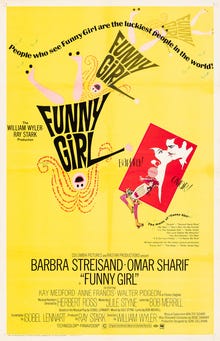
Previews
What, if anything, did we know about this coming attraction before we watched it?
Ellen: This is one that my Mom sat me down to watch at some point, and boy I’m glad she did!
Tyler: I think Barbra Streisand is in this? Right? Maybe? I don’t know, let’s find out.
Plots & Feelings
This one’s pretty self-explanatory.
Short Version (courtesy of IMDb): The life of Fanny Brice, famed comedienne and entertainer of the early 1900s: her rise to fame as a Ziegfeld Girl, her subsequent career, and her personal life, particularly her relationship with Nick Arnstein.
Long Version (modified from Wikipedia and formatted to fit your screen):
Fanny Brice strides into the New York City theater housing Ziegfeld Follies, her name shining in lights on the marquee. She briefly addresses herself in a mirror backstage (“Hello, gorgeous”) and proceeds to the stage. Fanny sits in the first few rows, awaiting the return of her husband Nicky Arnstein. Where is he, exactly? That’s a long story…
Tyler: Ooooh so this is what “Hello gorgeous” is from! I knew the line, but not the origin. It hits harder knowing how Fanny’s insecurity about her appearance impacts her throughout earlier parts of the movie.
Tyler: Also, the opening credits had a “Furs by” credit, which I don’t think I’ve ever seen before but is pretty immediately justified.

Back in Fanny’s youth, she was just a stage-struck young Jewish woman who landed a job in vaudeville. Despite a literal chorus about how plain-looking she is from her mother’s friends, Fanny just about skips off to work. Unfortunately, she’s not much of a chorus girl, and she’s promptly fired for not hitting her marks and having skinny legs, I guess1.
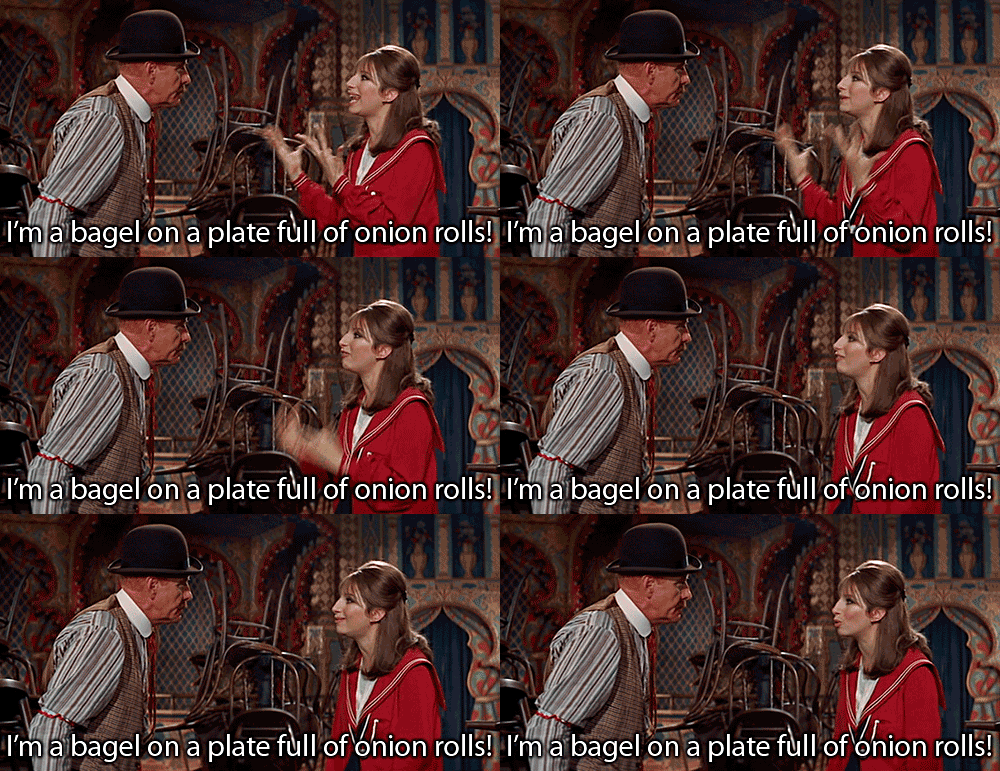
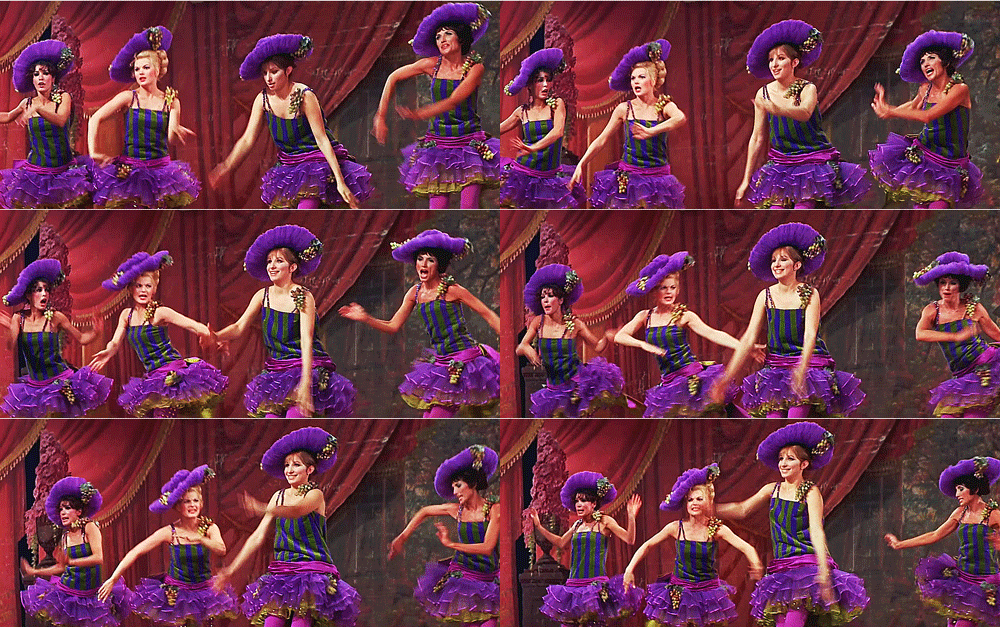
The piano player, Eddie, throws her a bone and says he’ll put her in another number if she can rollerskate. She lies and says yes, and during the show, she is all over the place, unable to keep in synchronicity with the others and nearly taking them all out. The audience loves it, finding her hilarious, and her singing in a solo number seals it as a banner night for Fanny Brice. Backstage, she kind of apologizes to the other performers, but come on: she ain’t sorry. While they’re talking, a man named Nicky Arnstein comes backstage to pay his compliments. He tricks the theater owner into signing Fanny for $50 a week2, though she declines his dinner invitation.
Ellen: The whole rollerskate number is crazy, from the costumes to the choreography. Streisand executing Fanny’s “mistakes” takes just as much coordination as doing the actual routine. It’s worth a watch!
Tyler: Agreed! I was very impressed by the whole thing. It also reminded me of that one team on America’s Best Dance Crew that danced on skates and blew my mind.
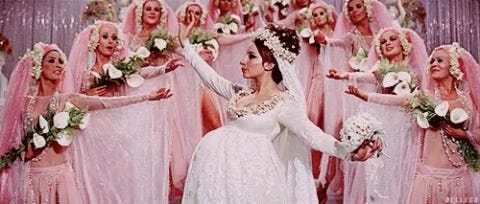
Six months later, Fanny hits the big time: she gets an audition with the Ziegfeld Follies! Mr. Florenz Ziegfeld sends a telegram to Mrs. Brice’s saloon, much to the delight of the folks on Henry Street. Fanny is hired, but there’s just one problem: Ziegfeld wants her to star in the finale. While that seems like wonderful news, Fanny is absolutely tweaking, because the entire number is about how love makes her the most beautiful bride in the world, and she simply cannot perform that straight. Her funnybone and insecurities won’t allow it! (Considering that the opening song was her mother’s friends singing about how she’s not pretty, I’m sympathetic.) When the time comes for her to be revealed in the finale, she’s a glowing, gorgeous… gigantically pregnant bride.
Profiles in Greatness (Source)
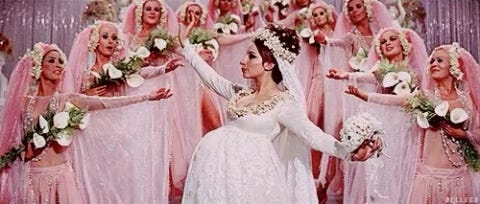




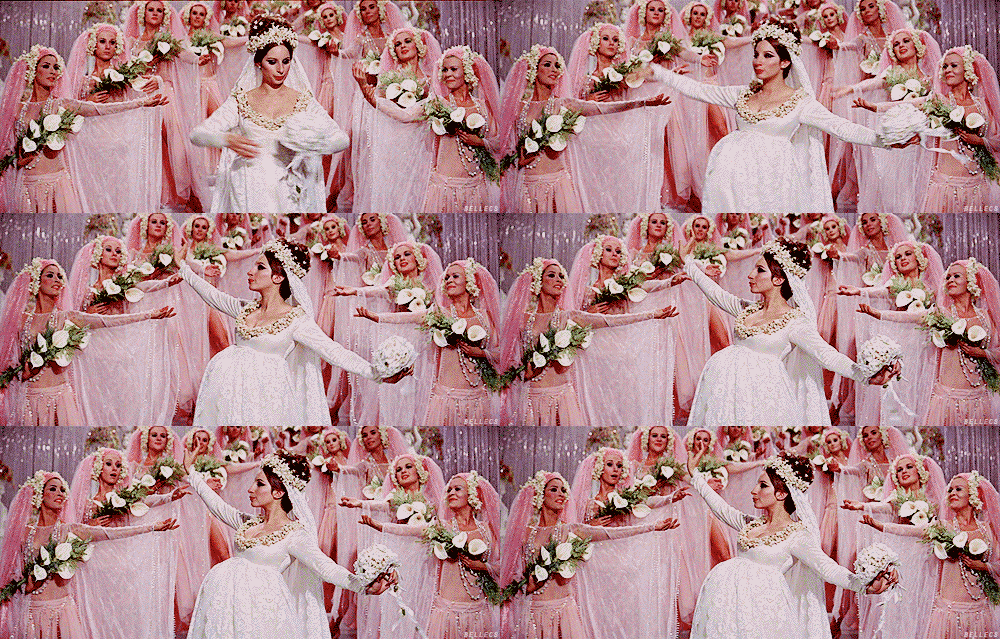
The audience loves it, and Fanny receives five or possibly six curtain calls. Ziegfeld thinks she made a mockery of his show, but he can’t argue with the response. Fanny insists that because they were laughing at her joke and not at her, it’s all worth it. Nick materializes to congratulate her, and she invites him back to the saloon. He likes her enough to, despite being a professional gambler, lose to her mother’s friends at cards. Fanny and Nick are all gooey-eyed toward one another, but he has to catch a train to Kentucky in the morning. He says he’ll call her when he’s back.
Ellen: He also goes on and on about not liking to be tied down by definite plans, which does not bode well.
Tyler: I wrote that line down because it was such a red flag: “I never have definite plans, they make me feel too tied down.” 🚨 An f-boy alert if I’ve ever heard one.
One year later: he has not called back3!! Fanny and the other Folly girls arrive off the train in Baltimore, and whomst should be on the platform but one Nicky Arnstein. Insultingly, he’s not even there to meet her: it’s actually Elsie. The blow is softened by the fact that Elsie is a horse, and Fanny begrudgingly accepts his invitation to dinner. After much debate, roast beef, and a back-and-forth song4, the two sleep together! The two spend a lot of the next week in Baltimore together, where Fanny has her first lobster (amongst other firsts…). Unfortunately (literally), Nick lost money on Elsie, so he’s going to board a cruise to Europe to make money off the rich passengers with nowhere else to go. Fanny decides that no one can rain on her parade, and despite the fact that Nick didn’t ask her to, she drops out of the rest of the tour and meets Nick on the boat!
Ellen: The reveal of Fanny belting out her song on a little tugboat reminded me so much of this moment from the 2007 Hairspray that I wouldn’t be surprised if Funny Girl was an inspiration.
Tyler: It was also some impressive camerawork (presumably using a helicopter; were drones invented yet?) to get that swooping climactic shot. The song is a banger too, I see why you called it the “Defying Gravity” of the play.
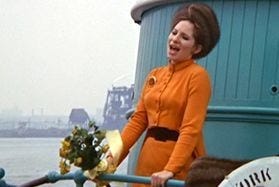

Nick is thrilled to see Fanny, but, as he tells her over creme de menthe frappes, he can’t marry her without a nest egg. It just so happens that the high rollers are playing tonight, and despite Fanny’s utter inability to keep a straight face while watching, Nick strikes it big! Time flies by as the two marry, buy a lavish country estate, and have a daughter named Frances who is basically never mentioned again. Fanny eventually returns to work at the Follies.
Seemingly just as quickly as they acquired it, they lose the house because Nick’s business ventures have a habit of failing. On Fanny’s first opening night back, Nick misses the show because he’s at a gambling hall trying to win the money back. Fanny is sitting in their apartment, smoking in silence when Nick finally arrives home. He resents her success, she resents his lack of responsibility, Frances probably resents them both for ignoring her5. Her mother tells Fanny to take her love goggles off and help him. This bit of motherly advice apparently needed to include a section about actually speaking to him, because Fanny attempts to make him feel important by trying to hide her part in a business deal that could make him a partner in a new casino. It doesn’t go well!!
Ellen: Fanny and Nick have other problems, but that storytelling trope of couples simply refusing to communicate goes down bitterly every time.
Tyler: I’m convinced that a good 20-30% of the movies we watch would simply not exist if their main characters just sat down and talked out their problems.
Nicky is feeling emasculated and useless, so he gets involved in a deeply shady bond scheme. Fanny gets offstage one night only for Eddie and Mr. Ziegfeld to tell her that Nick has been arrested. She charms the waiting reporters but falters as to if she still loves him. Fanny sees her husband before trial, and some combination of his pride, sense of honesty, and desire to yeet himself out of their marriage will not allow him to lie and say he didn’t know it was illegal. He knew. He wants to split up, but Fanny urges him to wait until he’s out of prison, and then they’ll decide.
Tyler: Fanny’s haircut would like to speak to the manager.
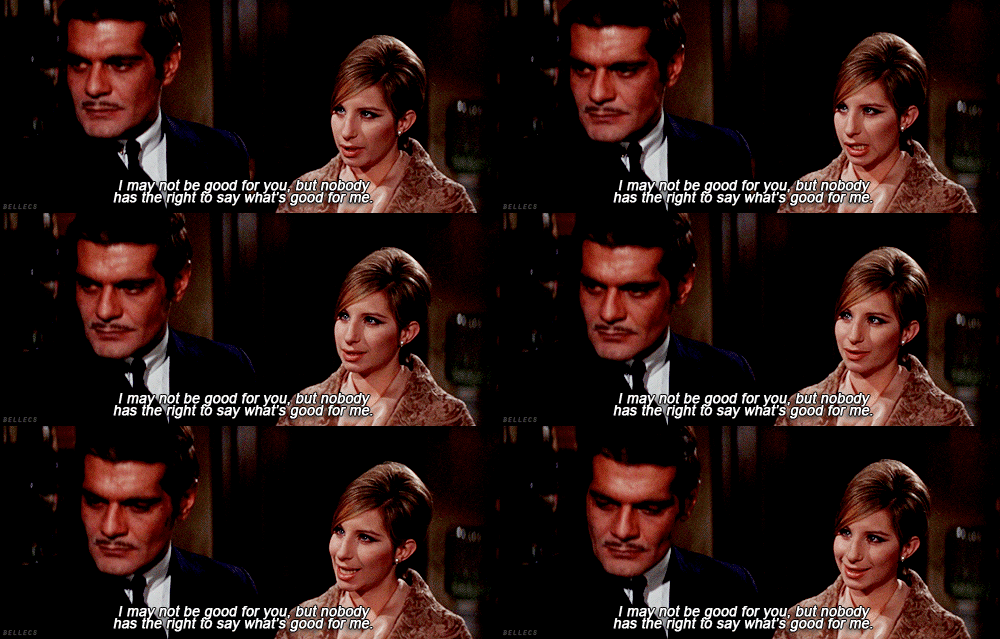

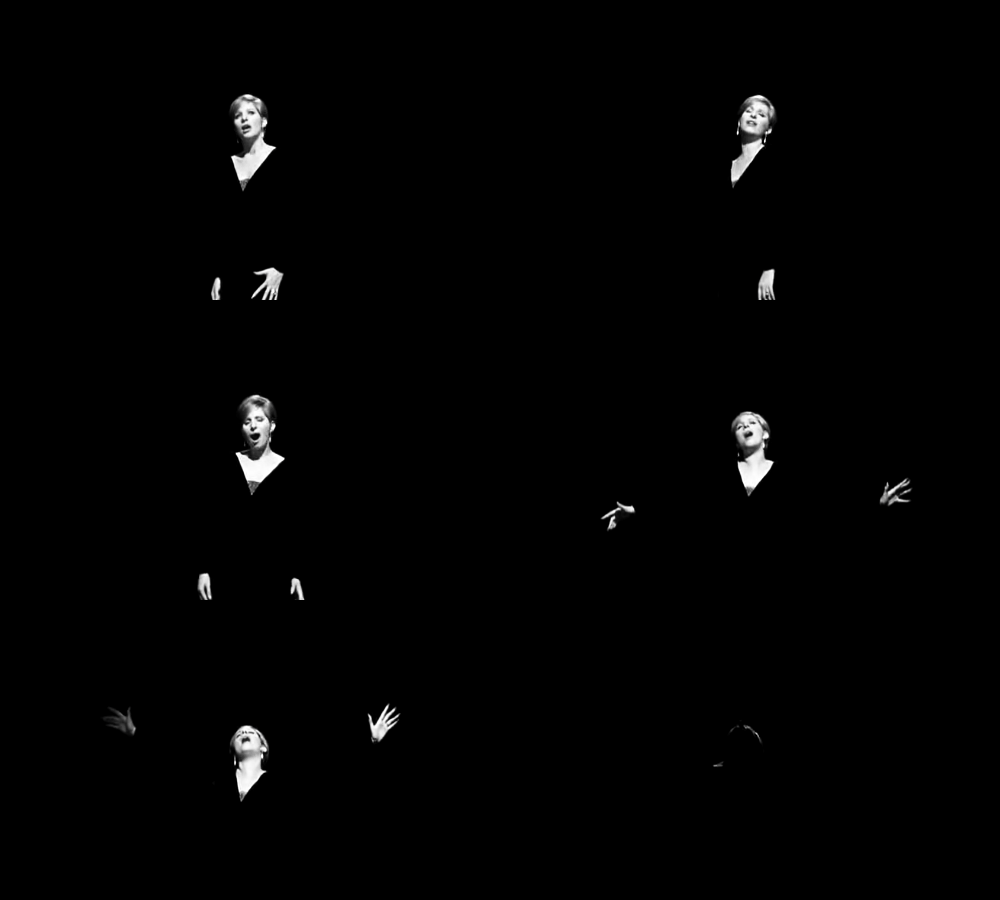
Eighteen months later, we’re back with Fanny at the theater. She’s informed that Nick has arrived, and she meets him in her dressing room. They come to the mutual decision to separate, and Fanny is heartbroken. Onstage, Fanny wears all black against a black backdrop, the theater swallowing her and her grief whole.

Intermission
Even though ILTBTA is free, please indulge us further and enjoy this quick “advertisement.”
This installment of ILTBTA is brought to you by … Brice’s Saloon!
Come on down to Henry Street and grab a pint of beer or a glass of Manischewitz in the finest saloon on the Lower East Side. Hang around until after the theatres let out and you might see a celebration for beloved-even-though-she’s-plain-looking performer Fanny Brice! She’s on Broadway now! That’s my daughter!
A portion of our proceeds this Hanukkah will go to Nicky Arnstein’s legal defense fund because he’s such a nice boy and there’s no way he did all those things he’s accused of! Don’t forget to mention ILTBTA and get a free ante into the card game in the back.
Take our advice and come to Brice’s: where it’s twice as nice as that place with mice (and lice!), you can enjoy in a vice (like rolling dice or smoking spice), and all at half (not thrice!) the price! (Hey, we never promised to be concise.)
Wiki-Wiki-Whaaat?
Love a good Wikipedia rabbit hole in search of some fun facts? Us too.
Funny Girl’s Wikipedia page has some interesting facts and anecdotes that we recommend you read through, but here are a few of our favorites:
Funny Girl is based on the successful musical of the same name, which debuted on Broadway in 1964. Also starring Barbra Streisand in the lead role, the play was produced by Fanny Brice’s son-in-law Ray Stark. Streisand was Stark’s first and only choice to play Brice on screen, though studio executives wanted Shirley MacLaine (who we’ve seen in The Turning Point).
Ellen: Whoa whoa whoa: there’s really a Fanny Brice??
Tyler: I literally did not learn that until doing this research. The power of Wikipedia!
The Funny Girl musical is itself a loose biography of the real-life comedian and actress Fanny Brice and her rocky relationship with gambler and con artist Nicky Arnstein. Though the movie portrays Arnstein as a swindler due to his hurt pride, he was a thief before they even married. Unlike the movie (again), where Nicky pleads guilty to fraud, the real-life Arnstein and Brice maintained his innocence in this case, which made it all the way to the Supreme Court before he ended with a two-year sentence at Leavenworth. The drama!
Director William Wyler took over Funny Girl after Sidney Lumet (who we know from 12 Angry Men and Dog Day Afternoon) dropped out for the ever-intriguing “creative differences.” Wyler, whose illustrious career we first got a taste of in our post on Ben-Hur, initially declined the offer from producer Ray Stark due to his “significant hearing loss” but eventually changed his mind, saying “If Beethoven could write his Eroica Symphony, then William Wyler can do a musical.”
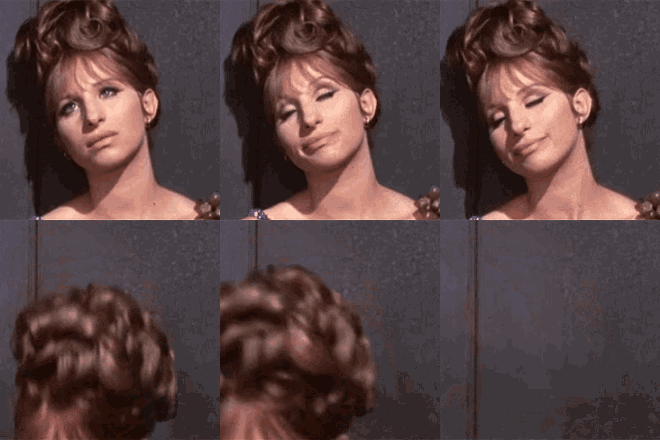
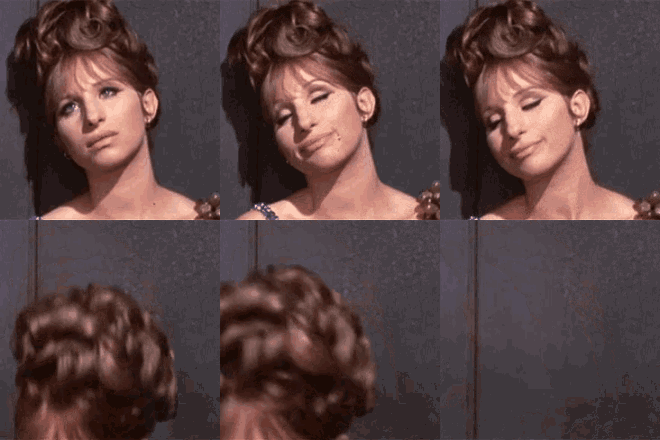
Wyler allegedly crafted different romantic scenarios for Streisand and co-star Omar Sharif (whom we first met in Lawrence of Arabia)6 to help foment romantic chemistry, such as putting Streisand’s trailer window in direct but hidden view of Sharif’s. The odd tactic worked, as the two had an affair during filming.
In addition to being the biggest movie star from Egypt and speaking five languages, Sharif was also a passionate bridge player, at one point being ranked among the world’s top 50 players. After playing in multiple World Bridge Olympiads, forming a traveling bridge “circus” to showcase and promote the game around the world, and writing several books on bridge, Sharif quit card games completely in 2000 because it felt like an addiction.
Another fun fact about Sharif: he voices Aslan in the Italian dub of The Chronicles of Narnia: The Lion, the Witch and the Wardrobe.
Funny Girl was a huge critical and commercial success, becoming the highest-grossing movie of 1968 and garnering eight Oscar nominations. Its only win was for Streisand, who famously tied with Katharine Hepburn (for her work in past ILTBTA post The Lion in Winter) for Best Actress (the only time that has ever happened) and said her character’s opening line (“Hello gorgeous”) when accepting her award.
Naturally, the film’s success spawned a slightly less acclaimed sequel, Funny Lady. Released in 1975, the film follows Fanny Brice (again played by Streisand) in her later life through her marriage to songwriter Billy Rose.
Honorable Mentions
What other movies should you be watching?
Did Funny Girl get you in the mood for a musical featuring strong Jewish performers? Well boy howdy do we have the Honorable Mention for you: Fiddler on the Roof. Based on the stage musical of the same name, Fiddler on the Roof follows a poor Jewish milkman named Tevye as he attempts to marry off his five daughters during a time of increasing tension in his largely Jewish village in imperial Russia. The film was a commercial and critical hit, becoming the highest-grossing movie of 1971 and earning eight Oscar nominations. It is widely considered one of the greatest musical films of all time.
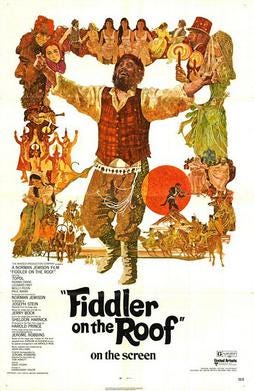

But don’t just take the word of some randos from the 70s, listen to us too! Ellen’s Spreadsheet comment calls it a “classic of stage and screen” and Tyler noted the “chaotic, over-the-top energy” and impressive choreography and songs. We watched this one during the pandemic (at three hours long, it was a great way to kill some time) and really enjoyed it, so we hope you do too.
Fiddler on the Roof is available to rent from all the usual streaming services. Happy Hanukkah!
Fill In The Blank
How did we really feel about The Academy nominating this?
Ellen: I’d like to invite The Academy back to the saloon for a beer and cards. Barbra Streisand is an absolute force of nature in this movie. She’s properly funny, which is a requirement given the name, she’s charming, and her singing can blow the roof off the place. While it strains credulity (to me, at least) that she’s not beautiful, I do appreciate that her rise to stardom does not involve some inexplicably-acquired dance skills or “grace.” In addition to being an auditory wonderland, it’s a feast for the eyes as well. The scale of the sets, some of which are only used for like three minutes, is bananas, and the costuming is so much fun. I have some small quibbles with the story that Tyler will get into below, but that won’t rain on my parade!
Tyler: I’d like to buy The Academy a ticket to one of Fanny’s shows but not invite them to the afterparty at Brice’s Saloon. From the jump, Barbra Streisand knocks it out of the park as Fanny and embodies the best kind of “not like other girls” stereotype in a charming (if overpowering at times) way. And while she absolutely carries the movie on her back with her acting and singing, she can only take the rest of it so far.
Aside from a couple Act One numbers the songs weren’t all that memorable, and things really seem to drag in Act Two once Fanny and Nick’s relationship takes shape (such that it had one). Granted, since it was based on a true story I can’t knock it that much, but the whole “naive girl falls for a walking red flag and thinks she can change him then is heartbroken when he doesn’t” trope is a bit tired at this point. Or maybe I’ve just been watching too much Rory Gilmore, who can say.
Let The Credits Roll
Thanks for reading! Some quick housekeeping as you exit the theatre:
If you have plots and feelings of your own (on the movie or ILTBTA in general), feel free to comment on the post or simply reply to the email. If you liked reading this: tell your friends! If you hated reading this: tell your friends how much you hated it by forwarding it to them!
Since Twitter is a hellscape of hatred and Russian bots, we’ve taken our talents to Bluesky! Follow us there for alternate subtitles and even more jokes and gifs.
ILTBTA is also on Letterboxd, the social networking/movie review site for movie fans. Follow us there to read our Spreadsheet comments of our ILTBTA movies, plus our ratings of other movies we watch!
If you’d like to start a wild Best Picture journey of your own, feel free to download a copy of The Spreadsheet. Bonus: checking off the boxes is oddly satisfying.
Post-Credits Scene
Get a sneak peek at the next ILTBTA installment.
With our next post originally slated to fall right after some family-filled holiday celebrations, we’re opting to take a little holiday hiatus from ILTBTA. Fear not, though, we’ll be back in your inboxes in the new year (January 13th) with yet another post on a still-to-be-determined movie that chances are you’ve never heard of. If you’re still itching for some of our writing over the holidays, feel free to jump into the ILTBTA archive and re-read our posts on Christmas classics Miracle on 34th Street and It’s A Wonderful Life, or relive our holiday-timed honeymoon with our two-parter from three years ago.
Until then, merry Christmas, season’s greetings, con your family into going to the movies!
RIP terrible theater owner, you would have hated thigh gaps.
Wikipedia says Funny Girl takes place sometime before World War I, and my trusty CPI Inflation Calculator only goes back as far as 1913, so we’ll say that’s at least $1,650 a week in today’s vaudeville salaries!
Sounds like my ex-wife!
Ellen: Nicky’s lyrics in the song are comically simple, “You are woman, I am man,” whereas Fanny is having a full on philosophical discussion to herself about whether this is the right choice. A commentary on the difference between the difference in men’s and women’s considerations when engaging in intimacy?? Idk.
Tyler: Nah that can’t be it.
Ellen: Shout out to Tyler for continually remembering that these fools have a baby, because I keep neglecting to include her as well.
Tyler: The things we do for a joke …
Can’t stop won’t stop with the callbacks to our previous posts.